
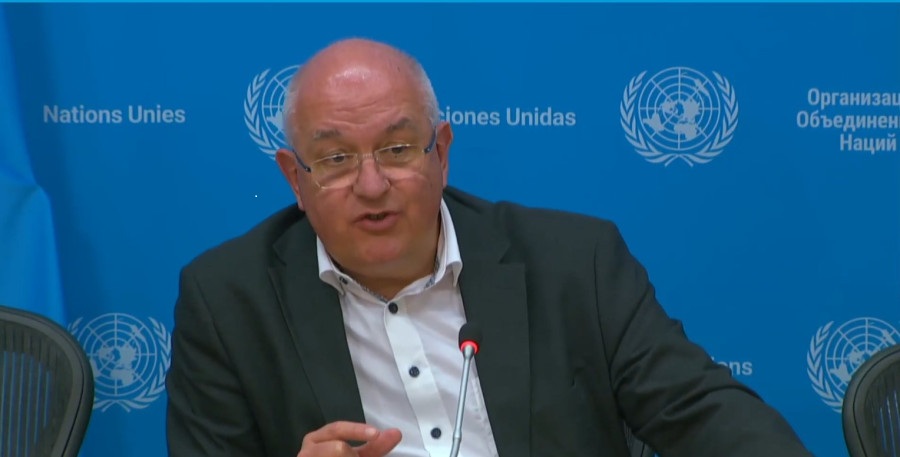
Speaking in Brussels today, the UN Special Rapporteur for Minority Issues, Nicolas Levrat, strongly criticised the EU over its double standards regarding minority protection in general and the continuing lack of protection for European minoritized and endangered languages.
The criticism came in his End-of Mission Statement after he finished the first ever official visit to the EU institutions to examine the EU’s compliance with standards in minority rights, particularly for minoritised languages.
“The European Union is instrumental in advocating for minority rights outside its borders, especially through its enlargement policy, but lacks the tools and motivation to effectively address minority issues within the bloc. This gap must be closed to guarantee better protection of minorities within the EU.”
“Respect for the human rights of persons belonging to minorities is one of the founding values of the EU,” Levrat said, noting that, “as the Commission does not recognise a clear EU competence in this area, the EU cannot adopt laws, policies or binding measures that directly protect minorities. As an alternative, the EU should promote an approach that compels Member-States to uphold this founding value.”
While commending the EU’s anti-discrimination approach, which covers all minority groups including migrants and their descendants, the Special Rapporteur urged the European Commission to adopt a more comprehensive framework for minority rights. “This would ensure a more streamlined approach to minority issues across the EU and address the needs of linguistic minorities, who are currently left out of EU strategies and policies,” he said.
Referring to European linguistic minorities in the official statement the Special Rapporteur continued. “While the EU recognizes linguistic diversity as a European Value in Article 3 of the TEU, it does not have a dedicated, binding legal framework to protect linguistic minorities. Further, linguistic minorities have no specific protection, as language is not a forbidden ground of discrimination indicated in Article 19 of the TFEU – despite being included as a forbidden ground for discrimination in Article 21 of the EU Charter of Fundamental Rights. The EU lacks the authority to enforce linguistic minority protection, leaving substantial responsibility to Member-States and to the Council of Europe’s European Charter for Regional or Minority Languages, which is the main legal instrument for protecting minority languages.
“I would suggest, in order to address linguistic minority issues, for the EU to base its action on Article 167 of the TFEU which states that “the Union shall take cultural aspects into account in its action under other provisions of the Treaties, in particular in order to respect and to promote the diversity of its cultures”; the diversity of EU cultures certainly includes the diversity of languages, including minoritised languages, and a support action, such as a Strategic Framework for endangered minority languages, would be welcome.”
At the press conference Prof. Levrat highlighted that the European Language Equality Network has, as one of its main recommendations to the EU, a proposal for a Strategic Framework for endangered and minoritised European language to be established, similar to the EU’s Roma Strategic Framework. Under the ELEN proposals such a EU-backed framework would be empowered to develop new binding measures that would both ensure protection and help finance a comprehensive programme of long-term language recovery.
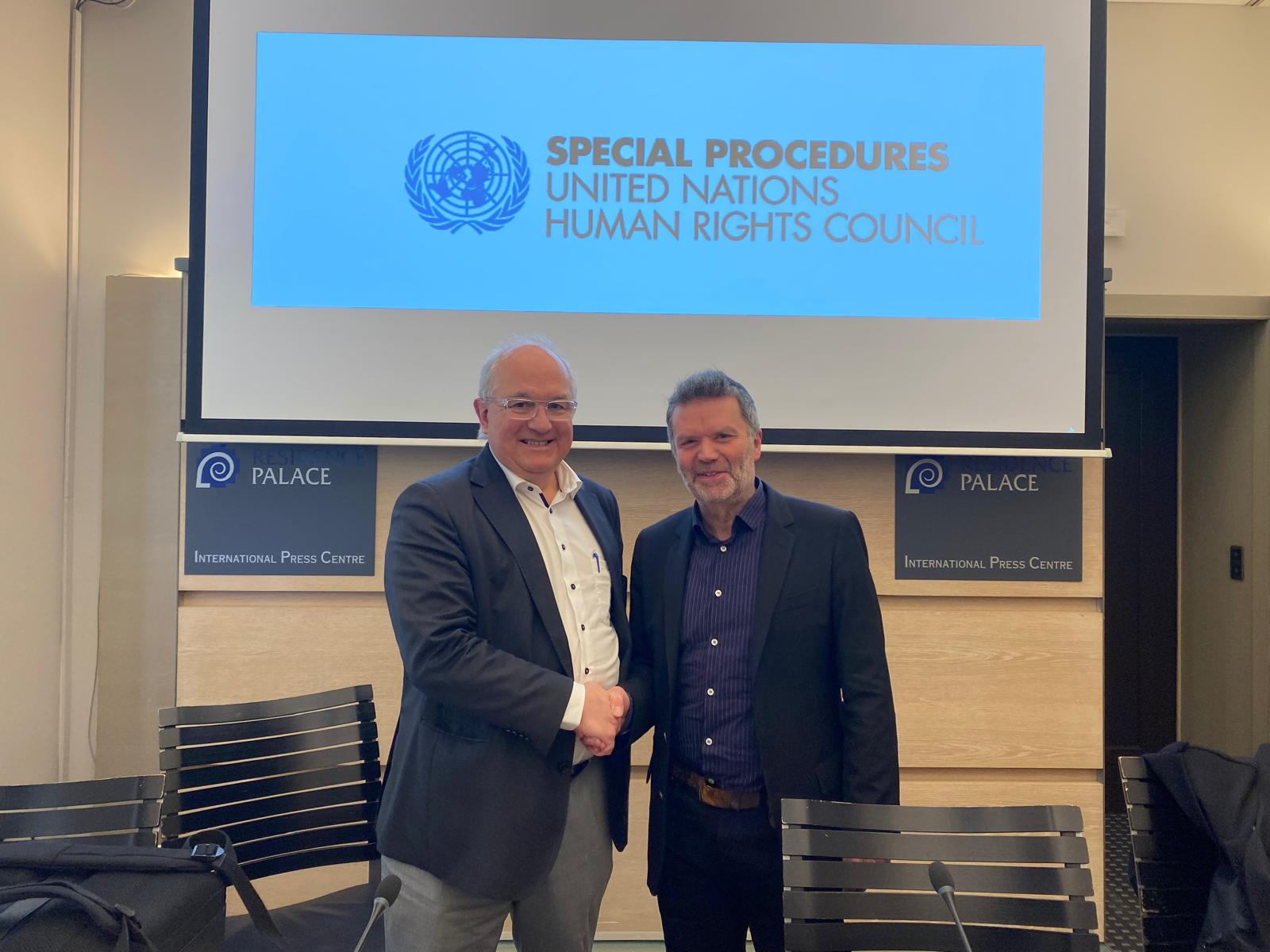
ELEN Secretary-General Davyth Hicks met with the Special Rapporteur earlier in the week to discuss the ELEN Recommendations to the EU. To follow up on the Special Rapporteur’s visit ELEN will be holding a series of meetings with key EU officials over the coming months to discuss the Special Rapporteur’s comments and ELEN’s recommendations for minoritised language protection, and to seek ways to work together with the EU to improve the situation.
The official Report of the EU visit will be presented to the UN Human Rights Council in March 2027. (Eurolang 2026)